In six months someone will ask you to show the change landed. Your licences are live, your people are guessing, and a usage dashboard won’t answer them. This is the method that will: 36 pages, 21 templates, and a worked example running through every one, built to be defensible in a boardroom.
Free, no email. Judge the standard before you spend anything.
Your people started using AI months before the program did. They’re using it on real work, with real data, and nobody has told them where the edges are. You’re not introducing a change. You’re governing one that already happened.
Training doesn’t fix this. A one-off session teaches people the buttons and leaves the judgement untouched, and judgement is the whole variable. Over-trust accepts a wrong answer. Under-trust refuses to use the tool at all. Both are failures, and neither shows up in a usage dashboard.
Then there’s the question nobody puts on a slide. Will this replace me? Leave it unspoken and it quietly kills buy-in, however good the rollout plan is.
The bones don’t change. This is the change-management method we run ourselves, kept whole and pointed at AI. What shifts is where the weight falls and what counts as success.
Prepare — 14 tools. Set direction before anything scales. The case for change, stakeholder analysis, readiness, guardrails, prioritised use cases, and the future-state view of how roles actually change.
Deliver — 5 tools. Run the plan. Communications that answer the job question honestly. Capability building that treats literacy as continuous, champions who spread fluency sideways, and adoption tracking that measures what people do with it.
Embed — 2 tools. Reward judgement, not volume. Measure value against the use cases you prioritised, and guard against over-reliance. Then hand it to business as usual with a named owner and a date.
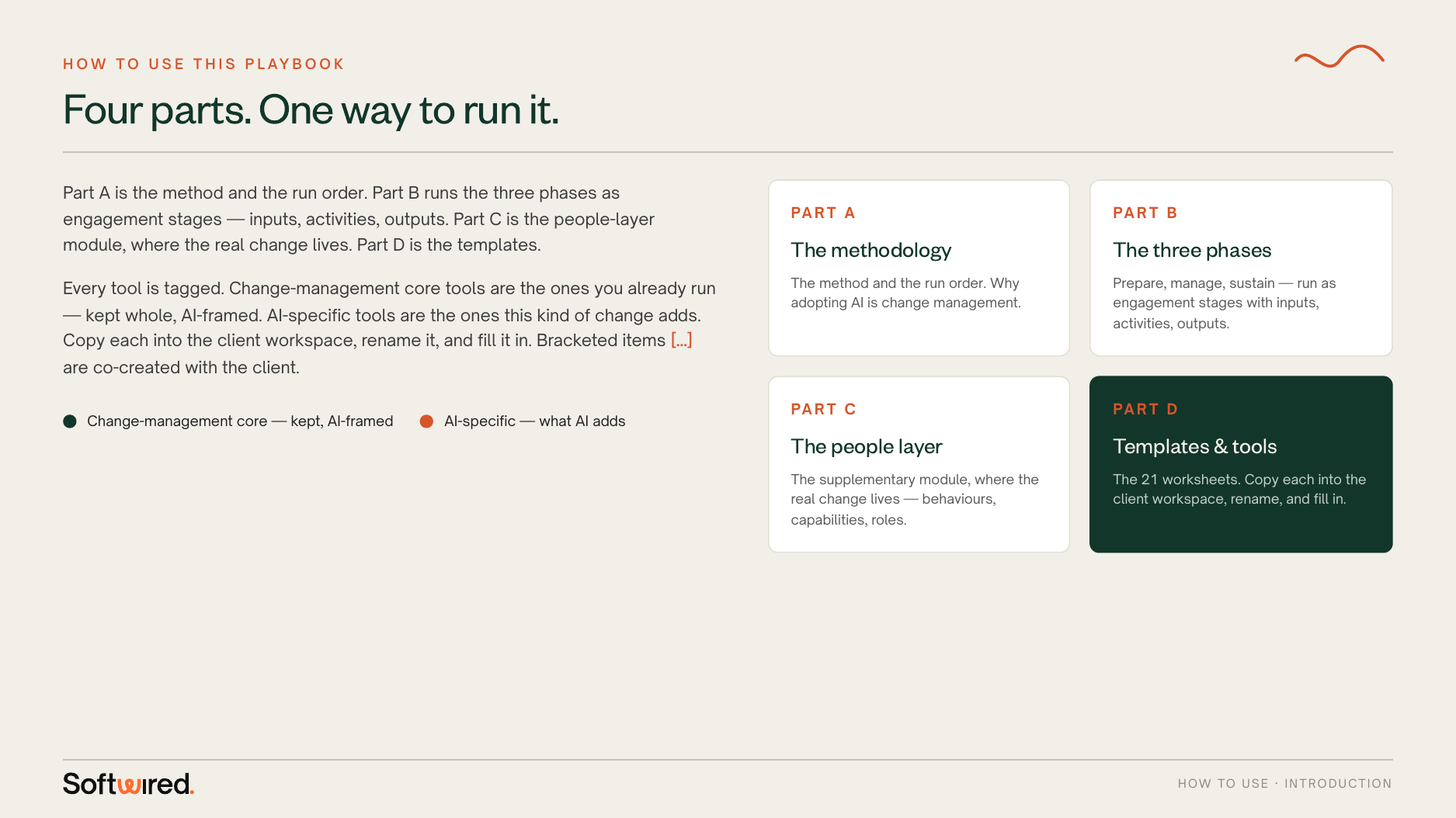
Every tool carries a purpose statement, a how-to-run note, and a greyed worked example in the first row, so you’re never starting from an empty page. Bracketed prompts show what to co-create with the business and what to decide yourself.
The methodology. What changes when the technology is AI, and where the weight shifts.
The people layer. Behaviours, capabilities, and how roles evolve. Scope a rollout as training and this is the part nobody writes.
21 templates. From the case for change through to the handover to business as usual.
The adoption heatmap. One view of where AI use should land across the organisation, and in which mode.
If you haven’t bought the licences yet, this is early. The method assumes tools are already landing. If what you need is a policy on acceptable AI use, that’s governance, and this isn’t it. If you want something to hand a sponsor, not a program to run yourself, start with the playbook and stop there. We’d rather you bought the one you’ll use than all three.
Cassy Barnes, Head of Change & Adoption at Softwired, wrote this playbook. She measures benefits realised, not training delivered.
Softwired is a Brisbane consultancy working on digital and AI programs that have to land in practice. We wrote this because we needed it. The change-management toolkit we already ran held up under AI, but it was missing the tools this kind of change demands. So we built them, and this is the version we run now. This is the part of the work we like most — finding out whether people actually changed how they decide. Not whether they logged in.
Choose how far you want to take it.
Three ways in, least support to most. Start with the playbook, take the full kit and run it yourself, or bring us in to run it with you. The free template below costs nothing either way. Prices shown are placeholders for review — not final.
One template — the adoption heatmap — free, filled in, no email. If it isn’t the standard you expected, don’t buy the rest.
Read the playbook and if it doesn’t give you a method you can run, email us within 30 days and we’ll refund it. Keep the file either way.
30 days to change your mind. Keep the file either way.
Take it and run it yourself, or bring us in to steer it alongside your team.
Get the playbook30 days to change your mind. Keep the file either way.