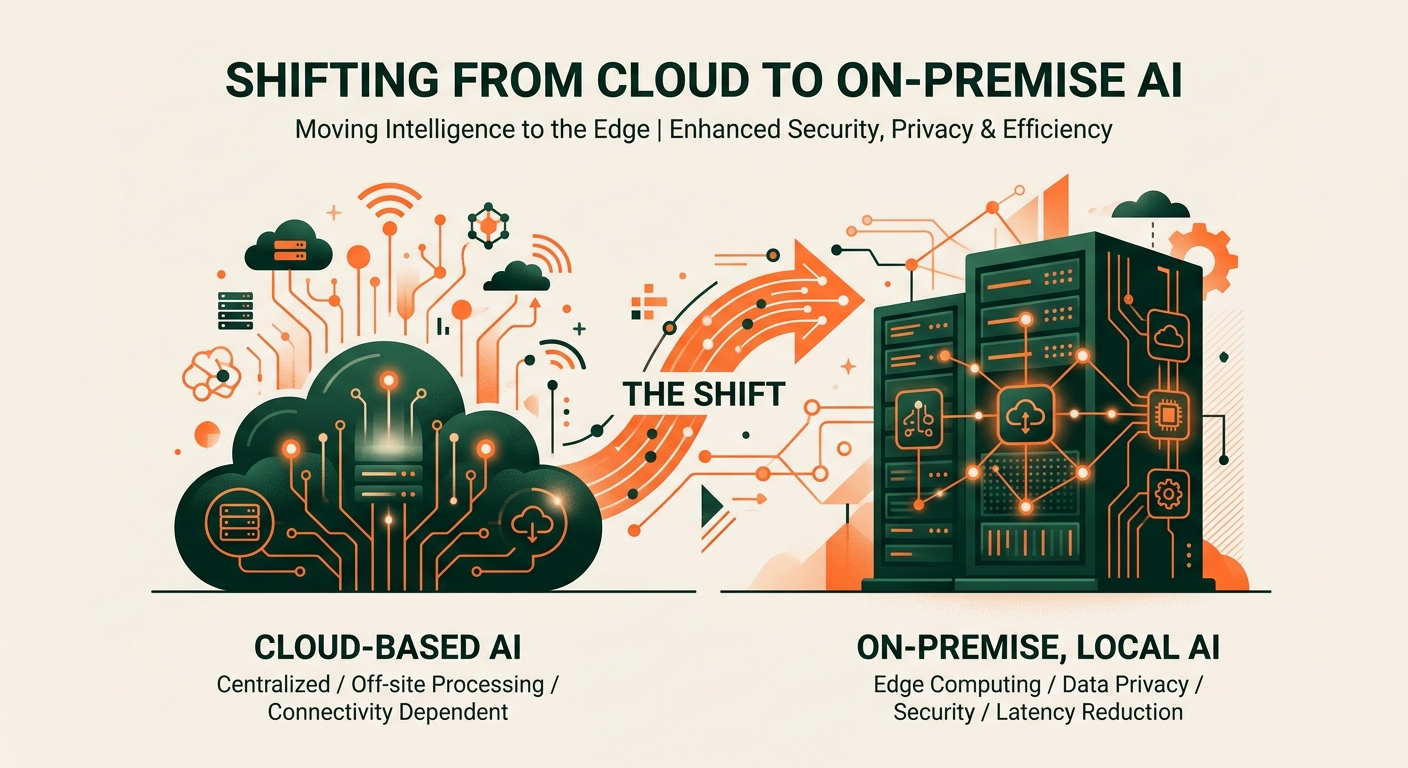
Last week my AI bill tripled overnight. Anthropic blocked OAuth for Claude on Openclaw, which means the tooling I had been running through my Claude subscription now has to bill against the metered API. Same work, three times the invoice. There is a survey doing the rounds over the weekend, which tells me I am not the only one feeling it. They are not happy about us doing this. They want us on the meter. I am not writing this as a billing complaint. I am writing it because the ROI on cloud-rented AI just collapsed in front of me, and most takes on Apple's new CEO are missing why that matters. The Apple II play, run again Apple just put John Ternus, a hardware engineer, in the CEO chair. The standard reading is that this is defensive. Hat tip to Nate B. Jones, who is one of the few commentators framing it correctly: this is the Apple II play, run again. Rewind to 1977. Compute was rented. You bought time on a mainframe sitting in someone else's building, paid by the minute, and queued for results. Apple's bet was that the compute should live under your desk. The mainframe vendors laughed. Then they didn't. Look at AI today. Where does the compute live? Someone else's building. You rent it by the token. You queue. Your data leaves your perimeter every time you ask a question. This is the on-prem AI gap, and it is the most under-discussed AI strategy story in tech right now. Cloud AI economics are broken at the unit level Here is what my tripled invoice is actually telling me. The providers have been subsidising tokens to win category. The moment they pull the lever toward unsubsidised pricing, the ROI fails for the people doing real work. Anthropic blocking the OAuth path is a lever pull. They are sorting users into two classes — the casual subscriber whose usage they can absorb, and the builder whose usage they cannot. The builder is being priced out, or routed into enterprise contracts that solve their margin problem and leave mine in place. A two-class AI system is forming. Heavy users on owned silicon. Everyone else throttled, metered, or priced out. This breaks more than budgets. Agile delivery cycles assume cost predictability across a sprint. Per-token billing turns every iteration into a variable-cost gamble. That is a project management problem with an architecture answer. I was prepared to live with the risk when it was cheap. Now that it is not cheap, the cost-benefit has flipped, and I am moving. What I am actually doing Three things have changed in my delivery stack. Gemini is my default model for Openclaw. Not because it is better. Because the unit economics are different right now and I have customers to serve. I have built a framework that looks for determinism in Openclaw tasks and turns them into pluggable code. Every workflow that does not actually need a model gets compiled out of the model layer. The model is the last resort, not the first. This is the cheapest single solution architecture change I have ever made to a product, and it is paying for itself in invoices I am no longer receiving. I am aggressively moving agentic work off the cloud. Add the air-gap problem to the cost problem and the question is not whether to move. It is how fast. Every regulated client I work with is sitting in the same tension. We want the productivity. We cannot ship the data. Cyber security, regulatory compliance, and data strategy teams have been aligned on that constraint for years. Boards have been signing off on AI capability that would have failed a security review three years ago because the alternative was being left behind. That is risk management by deferral, dressed as governance. It is not a stable equilibrium. The buy-versus-rent calculation is about to flip on a lot of people. The procurement signal worth watching is not a thread on X. Law firms are quietly stacking Mac Minis to run models locally on privileged matter files they cannot put in the cloud. That is not a hobbyist signal. That is procurement, voting with budget. What this means for three audiences Nate segments this into three groups. I will use my own labels. Builders If your product is architected on rented compute, you have a margin problem and a moat problem. Both will hurt you in the same week. Instagram launched iOS only and stayed there for 18 months. Not an accident. They went where the premium users and the premium platform were, and they built the brand before they sprawled. The next Instagram-tier products will do the same on local AI. Build for the platform that owns the silicon and you inherit the economics. Architect on someone else's meter and you inherit theirs — along with the technical debt of every pricing change they ever push. I am rebuilding the parts of my own continuous delivery toolset around exactly this assumption. Determinism is plug-in code. Probabilism is a model call. Run the cheap path first. Buyers You are signing off on AI capability that would have failed a security review three years ago. You know it. The alternative was being left behind, so you signed. The next twelve months are going to test that decision. This is a business analysis exercise more than a procurement exercise. Start asking what total cost of ownership and ROI look like when the per-token meter stops running. Ask where your data sovereignty actually sits when the model lives on your hardware versus when every prompt and response crosses a vendor boundary. Ask your delivery teams whether their continuous delivery architecture survives a tripled invoice. Mine did not. I had to rebuild it. Yours will not either. This is also a change management problem, not just a procurement one. The architecture decision lands on people who built workflows assuming a particular cost curve, and who will need to relearn what good looks like when local models do most of the work. Users The privacy gap closes the way it always closes. With hardware that makes "your data never leaves the device" the default, not a setting. Premium AI is about to look very different from the chat-window-on-someone-else's-server we have all been living in. Apple is not chasing the cloud arms race. They are betting that AI you own, on a device in your pocket or a server in your building, will beat rented intelligence the same way the personal computer beat the timeshare. The bet Putting Ternus and his silicon team in charge says Apple's view of the next decade is hardware-led. Not flashy demos. Not capex spent on someone else's data centres. Silicon you own, running models you control. That is an AI strategy with the kind of unit economics a board can actually sign off on. I am voting the same way with my own architecture. Not because Apple told me to. Because the meter just told me to. History doesn't repeat. But Apple does.

