


Anthropic opened a research preview of Claude Duet on 21 October 2026, US time (Anthropic; CNBC). Duet is an app where Claude works as a proactive agent. It sends a morning brief, keeps an eye on the apps you connect, takes on larger jobs in the background, and asks before it sends a message, makes a payment, signs a document or deletes anything (Anthropic help centre; MacRumors). It runs on Claude Opus 5.5, and Anthropic's help page puts the limit plainly: "You can't choose a model" (Anthropic help centre; Engadget).
We think that line matters more than any feature on the list. Anthropic earns its money selling access to frontier models, and it has shipped a product where the model is a fixed part inside something bigger. The labs are building upward. For a business choosing AI tools, the software around the model now decides more of the result than the model itself. This post sets out our thesis, drawn from public research and first-hand use.
What Claude Duet does
Duet is a research preview for Claude Pro and Max subscribers in the US, and people join a waitlist while invitations go out in waves. It isn't on Team or Enterprise plans yet, though Anthropic says it plans to bring it there later (Anthropic help centre; VentureBeat). So for now, Australian businesses can only watch.
It comes as a standalone app for iOS and Android, and on claude.ai (Anthropic; Reuters via Investing.com). It works on its own computer in the cloud, so it keeps going after you close the app, and it uses its own cloud browser for sites that have no connector (Anthropic help centre; MacRumors). Anthropic says it can draw on more than 6,000 connectors and plugins in the Claude Marketplace, from QuickBooks and Stripe to Gusto, HubSpot and Docusign (Anthropic; VentureBeat).
Anthropic is open about the gaps. Duet checks your accounts at set intervals, every few hours, so something urgent can land between checks, and Anthropic says checking nonstop would burn through plan limits much faster. Slack works with limits, and Microsoft 365 isn't available yet (Anthropic help centre; Engadget). It also shares your plan's usage limits with the rest of Claude, and its background checks count towards them (Anthropic; Anthropic help centre).
Everyone is moving up the stack
Picture AI as a stack of layers, with the value moving up it over time. Our diagram shows seven of them. The bottom four are on the record. The top three are our view of what comes next.
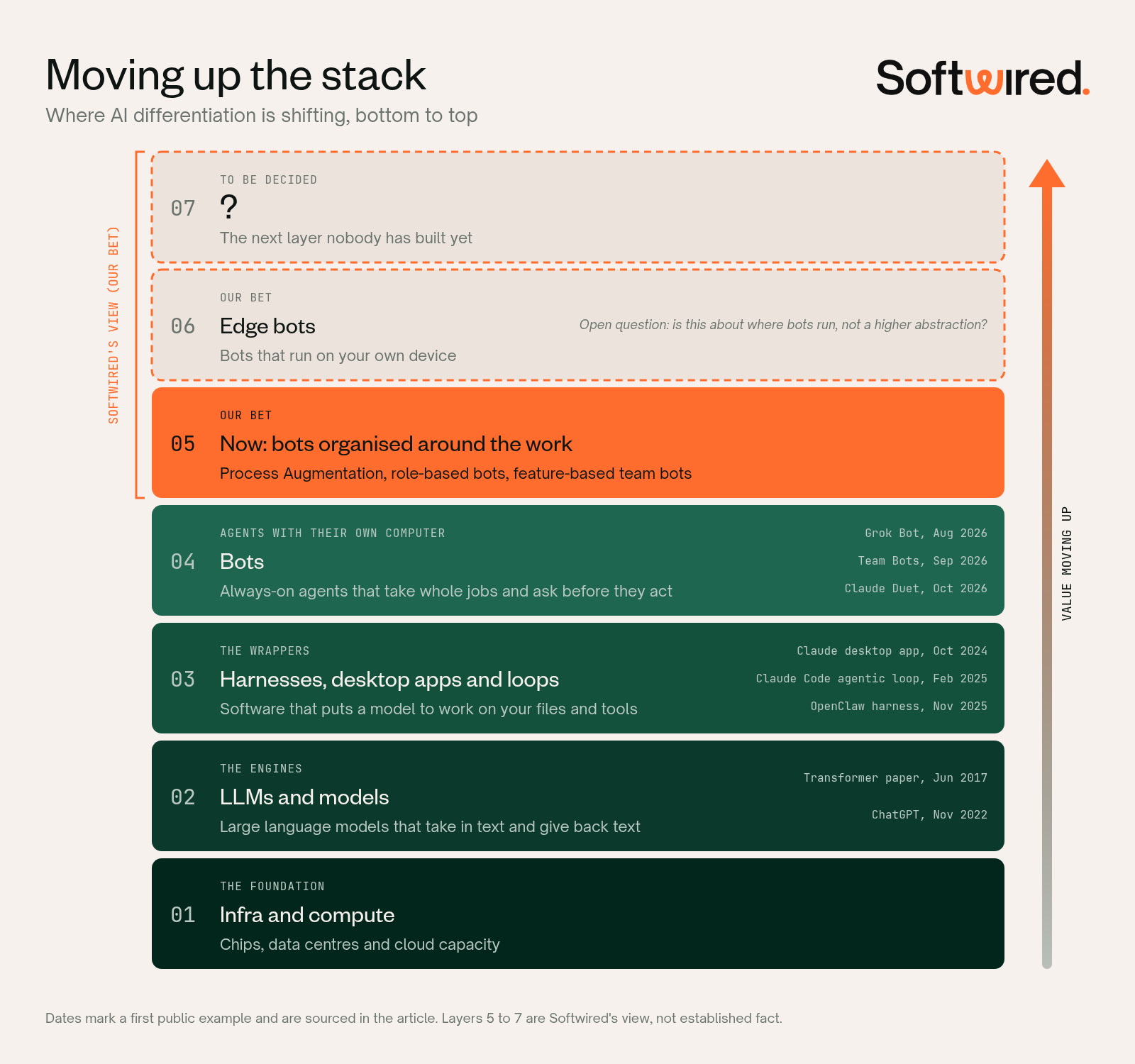
Layers 1 to 4 are established and dated from public sources. Layers 5 to 7 are Softwired's view, our bet, and are not established fact.
Network engineers have drawn a stack like this for decades. The OSI model, a reference model published by the international standards body ISO, splits network communication into seven layers, from the physical cables at the bottom to the application layer at the top (Cloudflare; IBM). Cloudflare describes each layer as abstracted from the one below it (Cloudflare; ISO/IEC 7498-1 summary). A web developer working at the top rarely has to think about the cables. We read the AI stack the same way. Each level hides the one beneath it, and as the lower levels become standard and cheap, the room to stand out moves up towards people and their work.
Infra and compute sit at the bottom, meaning the chips, data centres and cloud capacity everything else runs on. The models sit on top of that. They are the engines, and the modern run of them traces back to Google's Transformer paper in June 2017 (arXiv; Google Research) and reached the public with ChatGPT in November 2022 (OpenAI; Ars Technica).
The third layer is the wrappers, meaning the software around a model that puts it to work. It covers harnesses, desktop apps and agentic loops. Anthropic shipped Claude desktop apps for Mac and Windows in October 2024 (The Verge; Ars Technica). In February 2025 it released Claude Code, a terminal tool that reads code, edits files and runs tests in a loop (Anthropic; Simon Willison). OpenClaw, an open-source assistant that runs on your own machine and works with models such as Claude or GPT that you can swap in, was first published in November 2025 (GitHub; Wikipedia).
Bots are the fourth layer. They are always-on agents with their own computer that take a whole job and ask before they act. Grok Bot launched in beta in August 2026 (The Verge; MacRumors). In late September its makers launched Team Bots, shared bots that a whole team works with in its own Slack channels (Team Bots announcement; Team Bots docs). Duet is Anthropic's answer to Meta's Muse and OpenAI's dots, two personal agents that reached the market first (CNBC; Engadget). Each of these companies could sell model access and stop there. All of them are building the layers above.
We made the same observation earlier this month when we placed AI companies on one risk scale. The labs that sell closed frontier models are also the ones moving into products like bots and harnesses.
What we mean by a wrapper
A wrapper, also called a harness, is the software around a model that puts it to work. The model takes in text and gives back text, and the wrapper decides what it sees, which tools and accounts it can use, what it remembers, when it runs, and what it has to ask a person before it acts.
Think of a car. The engine matters, and a weak one limits everything else. Yet people choose a car for how it drives and how safe it feels, and few could name the engine supplier. Look at Duet again. Every feature in the list above belongs to the wrapper: the morning brief, the cloud computer, the connectors, the approval step before a payment, the limit on how often it checks your accounts.
The fair objection is that the model still matters, and it does. A stronger one reasons better, plans better and makes fewer mistakes, and the labs will keep competing hard on that ground for years. Our view is that among the leading models the gap has narrowed enough that the wrapper now decides most of what a business gets out of AI on an ordinary Tuesday.
A switch at Softwired
Softwired founder James Hallam has spent the last two weeks moving his own work almost entirely from Claude Max to Grok Bot. What moved him was how each product fits his working day: where the bot runs, which of his tools it can get into, and how it hands work back to him.
Grok Bot is a computer-use agent that runs in the cloud and works from the accounts and tools you connect to it (4Geeks; Team Bots docs). For James, those parts of the product weighed more than the model behind it.
What comes after bots
Most bots today are personal, with one assistant per person working from that person's accounts, and Duet is that kind of bot. Grok Bot started that way before Team Bots arrived (Team Bots docs; 4Geeks). We think the next step, layer 5 in our diagram, organises them around the work itself, in two forms for business and one for software teams. Above it we expect edge bots on your own device, and above that something nobody has named yet.
Process Augmentation
Process Augmentation is our name for putting a bot inside an existing business process so it improves a step while the people stay in that step. Process automation removes a step and hands it to software, while augmentation keeps the people and gives them a teammate that does the heavy lifting.
The pattern we have in mind gives each process or artefact its own bot, and that bot sits in a shared channel with the people who own the work. They tell it their intent (who they are, what they need and why) and point it at a spec. The bot does the work. People check it before anything goes out. The channel holds the feedback loop, and the know-how builds up with that bot and the people around it.
Here is how we picture it with an email campaign, often called an EDM. In the setup we have in mind, the campaign ships as a designed image, with variables for the headline and hotspots for the buttons, so when marketing wants a new headline the job goes back to design for a full rebuild. It's a slow loop. Under Process Augmentation, marketing, design and one bot share a channel. The campaign owner asks for a new hero headline and a different button colour for a variant, because the promotion goes live on Tuesday. The bot edits the variables in the source file, exports with the agreed presets, and posts the result. The design lead approves it in the thread before anything publishes.
Workflow tools such as Zapier and n8n already chain a trigger to a set of fixed actions (Zapier; n8n). This differs in that people describe the work in plain English, and the channel and the tools granted to the bot set its boundary.
Role Based AI
Role Based AI means building a bot around a job someone does, such as account manager, campaign owner or data analyst, with the access, knowledge and approval steps that job needs. Grok Bot already ships this pattern. Its Team Bots are built "around a role or workflow your team shares", with prebuilt bots for a sales account, marketing review and data questions (Team Bots announcement; 4Geeks).
Feature-based team bots for software
For software teams, Grok Bot's announcement applies the same idea by feature. It describes an Engineering Team Bot that works from a project's Slack channel, triages bugs and launches cloud coding agents for well-defined fixes. Its prebuilt EPD Teammate (EPD stands for engineering, product and design) is pitched as "the coordinator for your EPD team's project or feature" (Team Bots announcement; grokbot.guru). It says this setup helped five people ship more than 100 pull requests a day while they built Team Bots (Team Bots announcement; grokbot.guru). That figure is the company's own claim.
We read this as the software version of Process Augmentation, where one bot follows one feature and works with the product manager, the tech lead and the users who care about it.
Where does the stack top out?
We don't have a settled answer, so what follows is a working draft that we'd like to argue out in public.
Information architecture is a useful second lens. The Information Architecture Institute defines it as "the structural design of shared information environments", and Nielsen Norman Group describes a website's IA as how its content is organised, structured and labelled (Information Architecture Institute; Nielsen Norman Group). Once a business runs dozens of bots, it faces the same problem a large website does. Someone has to decide how the bots are grouped, named and found.
Working from first principles, each step up the stack wraps a bigger unit of work. A bot that does a task sits at the bottom. Process Augmentation wraps a whole process, and Role Based AI wraps a role. Above that we'd expect agents that serve a team or a function, then ones that run across a whole organisation, then ones that deal with other companies' agents across organisational lines. The highest abstraction we can see is intent, where a person states what should happen and the stack works out how.
We think the stack tops out with people. Purpose and accountability don't abstract away. Someone still has to decide what the business is for, weigh the trade-offs, and own the result when it goes wrong. On that reading the top layer will always be human judgement, and every layer below exists to serve it.
There's an honest tension in our own diagram. We put edge bots, meaning agents on your own phone or laptop, above Process Augmentation because we expect them to follow it. In OSI terms, though, where something runs sits closer to the physical end of the stack than to a higher abstraction. Edge bots may turn out to change where bots live without adding a new layer of meaning. We've kept them in place as a bet and flagged the question.
Private AI gets more practical as the stack matures
The lower layers are getting cheaper and smaller, and the evidence for that is strong. Stanford's 2025 AI Index reports that the price of using a model that matches GPT-3.5 on MMLU, a broad general-knowledge test for AI models, fell from US$20 per million tokens (a token is roughly three-quarters of a word) in November 2022 to US$0.07 in October 2024, a drop of more than 280 times (Stanford AI Index 2025; Epoch AI). Epoch AI's newer analysis, on a separate dataset, finds the cost of a given level of performance has fallen about 13 times a year since 2023, and the AI Index puts the range at 9 to 900 times a year depending on the task (Epoch AI; Stanford AI Index 2025).
Small models have improved just as fast. In 2022 the smallest model to score above 60% on MMLU was Google's PaLM, with 540 billion parameters, the internal settings a model learns and a rough measure of its size. By 2024 Microsoft's Phi-3-mini cleared the same bar with 3.8 billion (Stanford AI Index 2025; Microsoft Phi-3 report). Microsoft says it ran a compressed version fully offline on an iPhone 14 (Microsoft Phi-3 report). Open-weight models, the ones anyone can download and run, trail the best closed models by a few months on Epoch's measure (Epoch AI; Stanford AI Index 2025).
Softwired founder James Hallam reads this as the commoditisation argument playing out at the bottom of the stack. As the upper layers carry more of the work (the context, the process, the role and the approvals), each task asks less of the model underneath. A smaller model becomes good enough for more jobs. His view is that this makes private AI practical for many more organisations, meaning open-weight models running on hardware they own and control. It is also what would make edge bots possible, since a model that fits on a laptop or phone can work without sending data anywhere. That is a view, and the cost of running and securing private hardware still has to stack up for each organisation.
Our bet
Layers 5 to 7 are our bet. We expect bots to be organised the way a business organises people, by role and by process, with channels as their workspaces in the way folders hold files. It's a thesis, built from the research above and our own first-hand use of these tools.
Any first trial would need to answer two questions. Does a dedicated bot cut the rework on a known handoff, such as that campaign email? And does a busy channel stay readable once a bot is posting in it? Until then, our advice for anyone picking AI tools this quarter is simple. Judge each one on its wrapper: what it can reach, what it remembers, where it asks permission, and how well it fits the way your people already hand work along.
- Anthropic Help Center, "Get started with Claude Duet", updated 21 October 2026
- Anthropic, "Introducing Claude Duet", 21 October 2026
- Ashley Capoot, CNBC, "Anthropic announces preview of Claude Duet, a personal AI agent to take on Muse, Dots", 21 October 2026
- Reuters via Investing.com, "Anthropic unveils Claude Duet AI agent app", 21 October 2026
- Igor Bonifacic, Engadget, "Claude Duet is Anthropic's answer to Meta Muse and OpenAI Dots", 21 October 2026
- Juli Clover, MacRumors, "Anthropic Launches Claude Duet, a Proactive AI Agent", 21 October 2026
- VentureBeat, "Anthropic's answer to Muse is here: Claude Duet", 21 October 2026
- "Team Bots: shared AI teammates that learn as they work" (Grok Bot announcement), September 2026
- Team Bots documentation
- 4Geeks, "Grok Bot Team Bots: shared AI teammates explained"
- grokbot.guru, "Team Bots let a whole team share one Grok Bot"
- Softwired, "AI Doom is a frontier-lab position", 8 October 2026
- Zapier Help Center, "Learn key concepts in Zap workflows"
- n8n Docs, "Key concept glossary"
- arXiv, Vaswani et al., "Attention Is All You Need", June 2017
- Google Research, "Transformer: A Novel Neural Network Architecture for Language Understanding", 31 August 2017
- OpenAI, "Introducing ChatGPT", 30 November 2022
- Ars Technica, "ChatGPT is one year old", 30 November 2023
- The Verge, "Anthropic's Claude AI chatbot now has a desktop app", 31 October 2024
- Ars Technica, "Perplexity and Anthropic's Claude get desktop apps", 31 October 2024
- Anthropic, "Claude 3.7 Sonnet and Claude Code", 24 February 2025
- Simon Willison, "Claude 3.7 Sonnet and Claude Code", 24 February 2025
- GitHub, openclaw/openclaw repository (created 24 November 2025)
- Wikipedia, "OpenClaw"
- The Verge, "Grok is now an AI 'teammate' you can assign work", 12 August 2026
- MacRumors, "Grok Bot Brings Always-On AI Agents to macOS and iOS", 11 August 2026
- Cloudflare Learning Center, "What is the OSI model?"
- Cloudflare Learning Center, "What is layer 7?"
- IBM Think, "What is the OSI model?"
- ISO/IEC 7498-1:1994, Basic Reference Model (catalogue summary)
- Information Architecture Institute, "What is information architecture?" (2013)
- Nielsen Norman Group, "Information architecture vs. sitemaps"
- Stanford HAI, "The 2025 AI Index Report"
- Stanford HAI, "AI Index 2025: State of AI in 10 charts", 7 April 2025
- Stanford HAI, AI Index 2025, "Technical performance"
- Epoch AI, "LLM inference prices have fallen rapidly but unequally across tasks", 12 March 2025
- Epoch AI, "The plunging price of thought", 2026
- Epoch AI, "Open models lag state-of-the-art closed models by 4 months", 2026
- Microsoft, "Phi-3 Technical Report: A Highly Capable Language Model Locally on Your Phone", arXiv, April 2024
