


Project intake is the process an organisation uses to receive requests for new projects, judge them consistently and decide which ones to fund. Good project intake software for a PMO on Jira supports five steps, each ending in a decision: request, triage, thesis, business case and a commit decision.
Intake is the first gate in any portfolio. Every project that later runs over budget or delivers nothing was approved somewhere, and intake is where you get the best chance to ask whether it should start at all. This method page sets out a process you can run with or without software, then shows how it maps to Tollgate inside Jira. For the wider picture, Tollgate's guide to Jira project portfolio management covers the rest of the lifecycle.
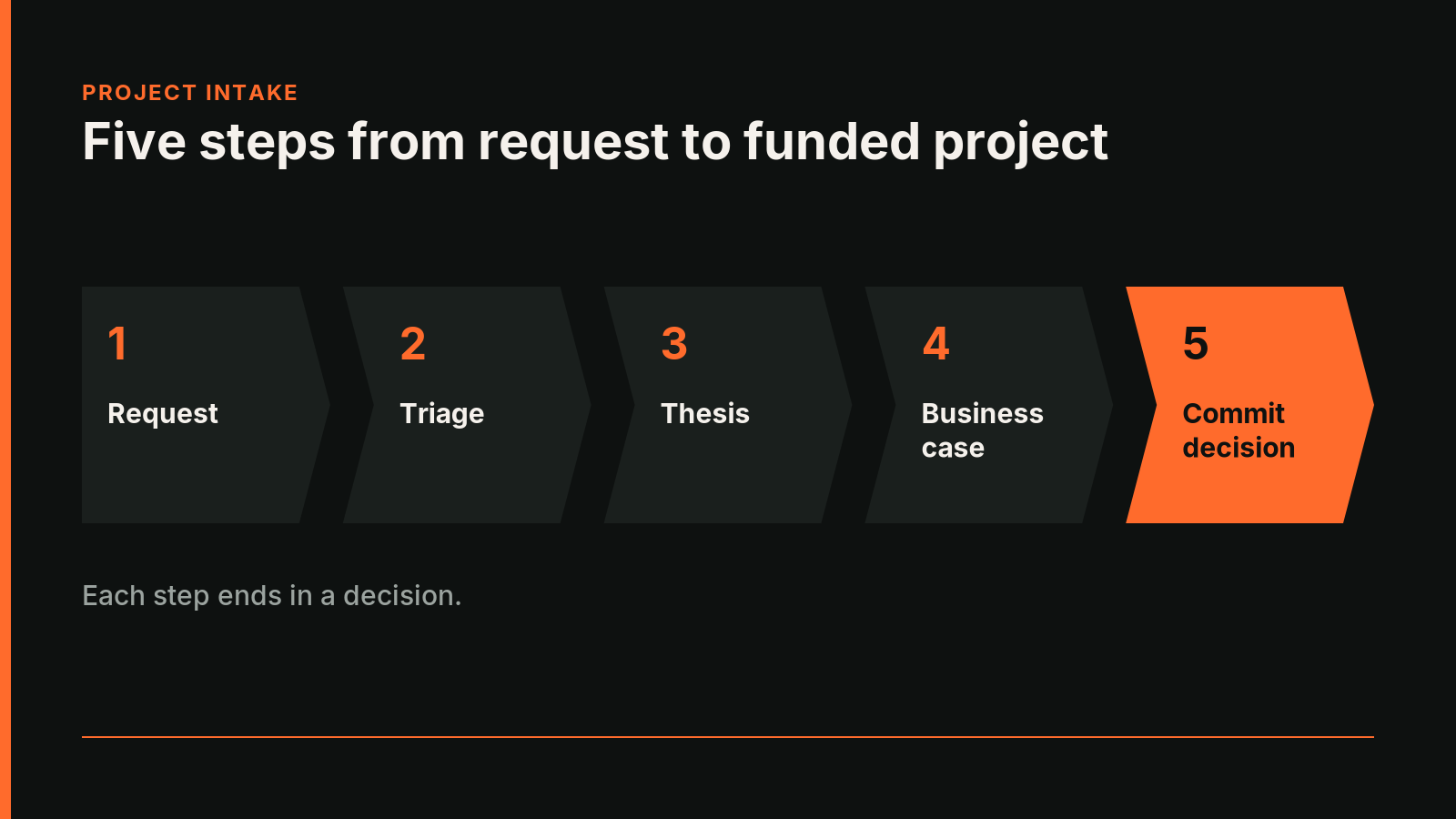
Five steps in a project intake process
Each step has one job and ends in one decision. Keep the early steps light, so good ideas are not lost to paperwork, and make the later steps rigorous, because that is where money is committed.
1. Request
Anyone with an idea or a need submits a short request. The request states the problem, who has it, and why it matters now. It does not need a cost estimate or a solution yet.
Decision: is this a request for a project, or something else, such as a service request or a small change a team can absorb?
2. Triage
The PMO or a small panel reviews new requests on a regular cycle. They check for duplicates, link related requests, and ask whether the problem fits the organisation's priorities.
Decision: proceed to a thesis, merge with another request, or close with a one-line reason the requester can read.
3. Thesis
The request owner writes an investment thesis: the problem worth solving, the outcome expected, and the return the organisation would underwrite. A thesis is short, and it is where weak ideas should fall away cheaply.
Decision: is the thesis strong enough to justify the cost of a full business case? If not, archive it with a rationale and keep it findable, because the same idea often returns later.
4. Business case
The thesis grows into a business case. It adds scope (what is in and what is deliberately out), a cost estimate, a financial case, the risks, and a plan for adoption and change. It names the sponsor who will decide.
Decision: is the case complete enough to put in front of the sponsor?
5. Commit decision
The sponsor reviews the business case and makes the commit decision. There are three sensible outcomes: approve, return with notes to address, or archive. The decision, the reasoning and the date are recorded, because the approved business case becomes the baseline every later gate measures against.
Decision: commit funding, return the case, or stop.
What a project intake form should ask
A good intake form is short enough that people fill it in honestly. Eight fields cover what triage needs:
- Requester name and team
- The problem, in the requester's own words
- Who has the problem, and how many people it affects
- The outcome that would show the problem is solved
- Why now: what happens if nothing changes for a year
- A rough size (small, medium or large), with no cost figure required
- A likely sponsor, if the requester knows one
- Related systems, projects or requests
Publish the form in one place and point every request channel at it, so requests that arrive by email or in meetings still end up in the same queue.
Leave the cost estimate and the financial case to step 4. Asking for numbers at intake tends to produce invented ones.
Running project intake in Jira with Tollgate
Many PMOs run steps 1 and 2 in Jira already, with a request form and a triage board. The gap usually opens at step 3, when a request becomes an investment and needs a thesis, a business case and a recorded decision.
Tollgate is a Forge app for Jira Cloud that covers steps 3 to 5 inside the Jira project. Its default method, SAM, groups six stages into three acts: Commit, Run and Realise. Intake sits in the Commit act, which holds the first two stages, Discovery and Approval. Tollgate also offers Green Book and other governance methods.
Discovery: the thesis
In Discovery, the project manager drafts the investment thesis in place on the project. The thesis holds the problem, the outcome and the expected return, written as prose a sponsor would say aloud. Tollgate does not reduce the return to a score. Candidates that don't survive pressure-testing are archived with a one-line rationale, and they stay findable.
Approval: the business case and the sponsor
The thesis becomes the core of the business case, with scope on both sides, design principles and a financial case. The financial case computes a forward ROI target using NPV, IRR and payback.
Before the case can be submitted, it needs a named sponsor and four Adoption and Change inputs. This is one of only two places Tollgate refuses to let you proceed, because adoption decides whether an investment lands. Everywhere else, Tollgate gives signals and leaves the call to you.
The sponsor then approves, returns the case with structured notes, or archives it. The sponsor can hold a governance seat without a Jira licence. In that case, the project manager sends the review link from their own mail client and records the sponsor's decision, with the reply attached as evidence. Tollgate emails nothing itself.
Keeping requests moving
A submitted case ages visibly against the site's monthly steering committee cadence: amber at 7 days, red at 14 and deep-red at 28. The signal appears on the screens the sponsor already opens, so a waiting decision is hard to miss.
Once approved, the investment moves into the Run act, where the first stop is Initiation. Tollgate's guide to stage gates in Jira covers the gates that follow, and the guide to whether Jira is a PPM tool explains where intake fits in the wider portfolio.
Frequently asked questions
What is the best project intake software for a PMO using Jira?
Look for software that runs inside Jira, records a thesis and business case for each request, names the sponsor who decides, and keeps the decision with its reasoning. Tollgate covers the thesis, business case and commit decision inside the Jira project.
What is the difference between project intake and triage?
Intake is the whole process from request to funded project. Triage is the second step, where the PMO checks each new request and decides whether it proceeds to a thesis.
Should an intake form ask for a cost estimate?
Keep cost out of the first form. A rough size is enough for triage, and the cost estimate belongs in the business case once someone has studied the problem.
What happens to rejected project requests?
Archive them with a one-line reason and keep them findable. The same idea often comes back, and the earlier reasoning saves time.
Who should run project intake?
The PMO usually runs triage and keeps the process moving. The decisions belong to sponsors, who approve or stop each business case, so name them early.
Tollgate is free for up to 10 users. Install free for up to 10 users.
Want to talk through how this applies to your team? Book a call with Softwired.
