


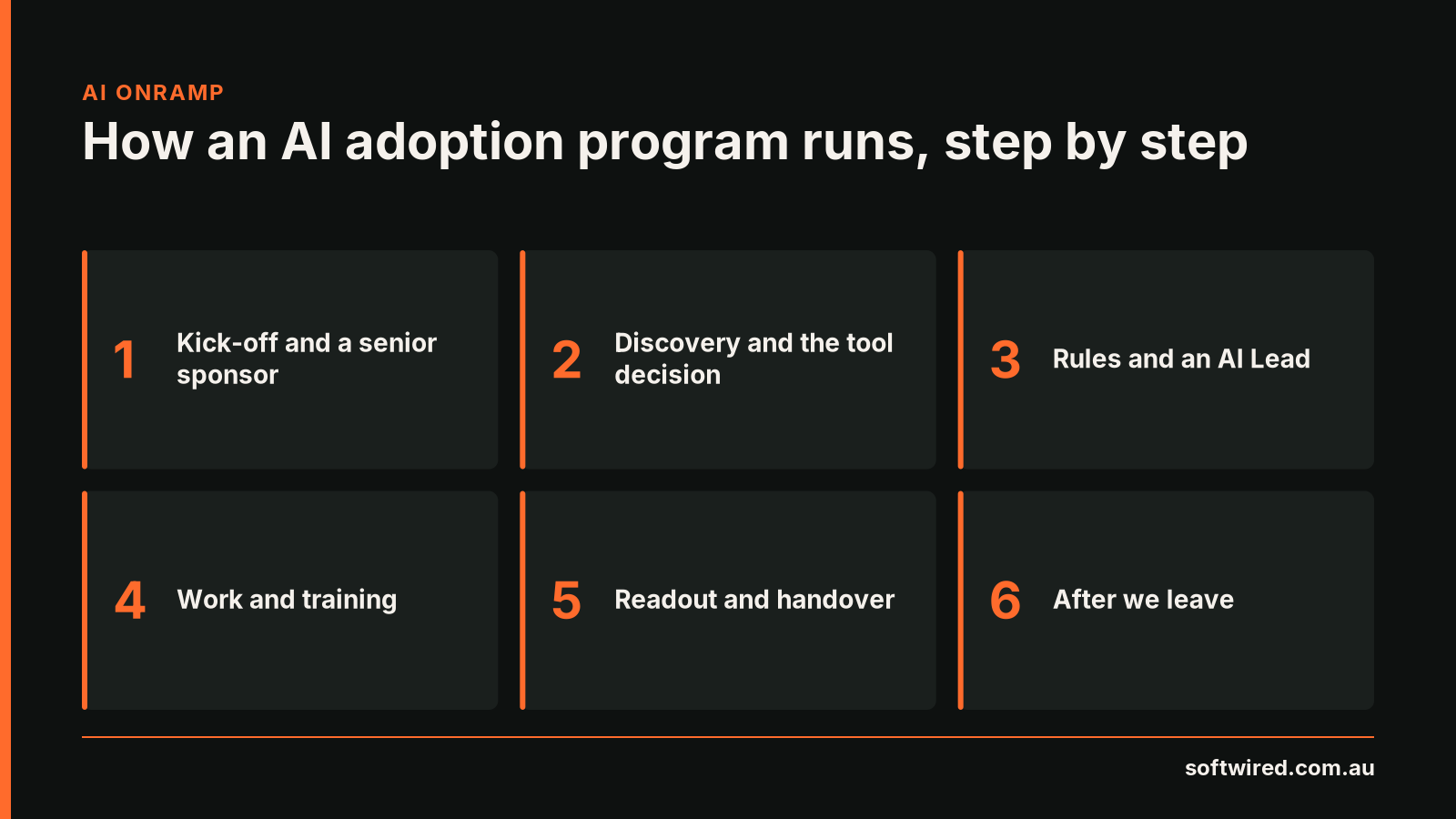
A mid-sized Australian business should start AI adoption by finding out which AI tools staff already use, then choosing a tool, writing simple rules, naming an owner and training staff on their own work. That order is the core of a practical AI adoption strategy, and it is how AI Onramp runs.
AI Onramp is the packaged version of Softwired's AI adoption work. It is for organisations whose staff already use AI tools at work with no rules in place. This article walks through each step in order: what your people do, and what you have at the end of it.
The problem usually looks like this. Staff use AI on personal accounts, often for good reasons. Nobody owns what is allowed, so nobody can say what data goes where, and the first person to ask an awkward question is usually a client. We start from where you are today.
Before kick-off
After you sign, one contact in your business answers a short online form we call the brief-in. Their answers select from our menu of options and set up the engagement, so the work is set up for your business before the first meeting.
Step 1: kick-off and a senior sponsor
You name a senior sponsor. This person backs the decisions that come later, including which tool the business will use and who owns the rules. Without a sponsor, AI adoption becomes a side project that stalls at the first disagreement.
You end up with a sponsor everyone in the business can name.
Step 2: discovery and the tool decision
Staff answer a no-blame survey about the AI tools they use and what they use them for. The survey includes an amnesty for past use, so people can answer honestly without worrying about what they did last month. Our guide to finding the AI tools your staff already use explains why the amnesty matters.
With that evidence in hand, leadership chooses the tool to back. We recommend the tool that fits your evidence. AI Onramp is model-agnostic, and we have no favourite vendor.
At the end of this step you have a picture of current AI use and a decision on the tool.
Step 3: rules and an AI Lead
The AI policy is written with you. You name an AI Lead, the person inside your business who owns the rules and two registers: the approved tools, and the approved uses. Our AI policy template shows the sections a policy like this covers.
The rules come before the rollout. Staff learn the tool and the rules together, so nobody has to unlearn a habit later.
At the end of this step you have written rules, an owner and two registers.
Step 4: work and training
Each team chooses the work it wants to improve. Every piece of work has an owner and a starting measure, recorded before any training begins. Staff are then trained on that work in the chosen tool, using their own documents, emails and reports. Where possible, a champion in each team keeps the practice going.
Each team finishes with training on its own work and a measure to compare against.
Step 5: readout and handover
The same survey runs again. Your sponsor sees what changed, measured the same way as before. We promise nothing up front, because nobody can know the result before seeing your work. The readout shows what happened.
Everything is then handed to your AI Lead: the rules, the registers, the measures and the training material. You own all of it when we leave.
Step 6: after we leave
Your AI Lead reviews the work each quarter. They drop what doesn't help and add what does. New tools and new vendor features keep arriving, so the registers stay live.
Every step ends with a check that must pass before the next one starts. If the evidence is thin after discovery, for example, we fix that before anyone chooses a tool.
Three sizes of the same AI adoption strategy
AI Onramp comes in three sizes. We choose the size with you on a discovery call, and you can take an item from the size above.
- Foundations. Typical fit (a guide only): Smaller teams, or anyone who needs the rules in place fast. What you end up with: A chosen tool, a one-page acceptable-use policy, a named AI Lead, staff trained on the basics, and three workflows.
- Growth. Typical fit (a guide only): Most organisations; the standard program. What you end up with: Everything in Foundations, plus five workflows, each with an owner and measures, training on the chosen tool, AI champions, a before-and-after readout and a forward plan.
- Transformation. Typical fit (a guide only): Larger or multi-site organisations, often run in waves. What you end up with: Everything in Growth across the organisation, plus the full policy and procedures and a number of workflows set for the engagement.
If you are still weighing up what an adviser should deliver at all, start with our guide to AI advisory services.
Frequently asked questions
How should a mid-sized company start an AI adoption program?
Start by finding out which AI tools staff already use, with a no-blame survey and an amnesty for past use. Then choose a tool on that evidence, write simple rules, name an owner, and train staff on their own work.
What is an AI Lead?
An AI Lead is the person inside your business who owns the AI rules and two registers, approved tools and approved uses. They review the work each quarter after handover.
Which AI tool does AI Onramp use?
AI Onramp is model-agnostic. Leadership chooses the tool to back after discovery, and we recommend the one that fits your own evidence.
How do we know which size fits?
We choose the size with you on a discovery call. The typical fit for each size is a guide, and you can add an item from the size above.
To talk through where your business would start, book a 30-minute call.
Want to talk through how this applies to your team? Book a call with Softwired.
