


AI advisory services in Australia are provided by independent consultancies, large professional services firms, resellers and software vendors. They give advice on where AI will help a business, which tools to back, and the rules and people needed to use them safely. A good engagement leaves you with five things you own, and this guide sets out what they are.
Softwired is a Brisbane consultancy, founded in 2010, that gives independent AI advice with no favourite vendor, alongside project delivery, change and Atlassian work. You can read how we approach it on our AI advisory page. This guide is written for the operations or IT leader who has been told to "do something about AI" and wants to know what to expect from an adviser before signing anything.
What AI advisory services should cover
Most leaders we speak to have the same starting position. Staff already use AI tools at work, some on company accounts and many on personal ones. Nobody can say with confidence which tools are in use, what data goes into them, or who decided any of it was allowed.
An adviser's job is to turn that position into something you can manage. The test of the work is what is still standing after the adviser leaves. A slide deck of use cases is easy to produce, and it rarely changes how anyone works on Monday morning.
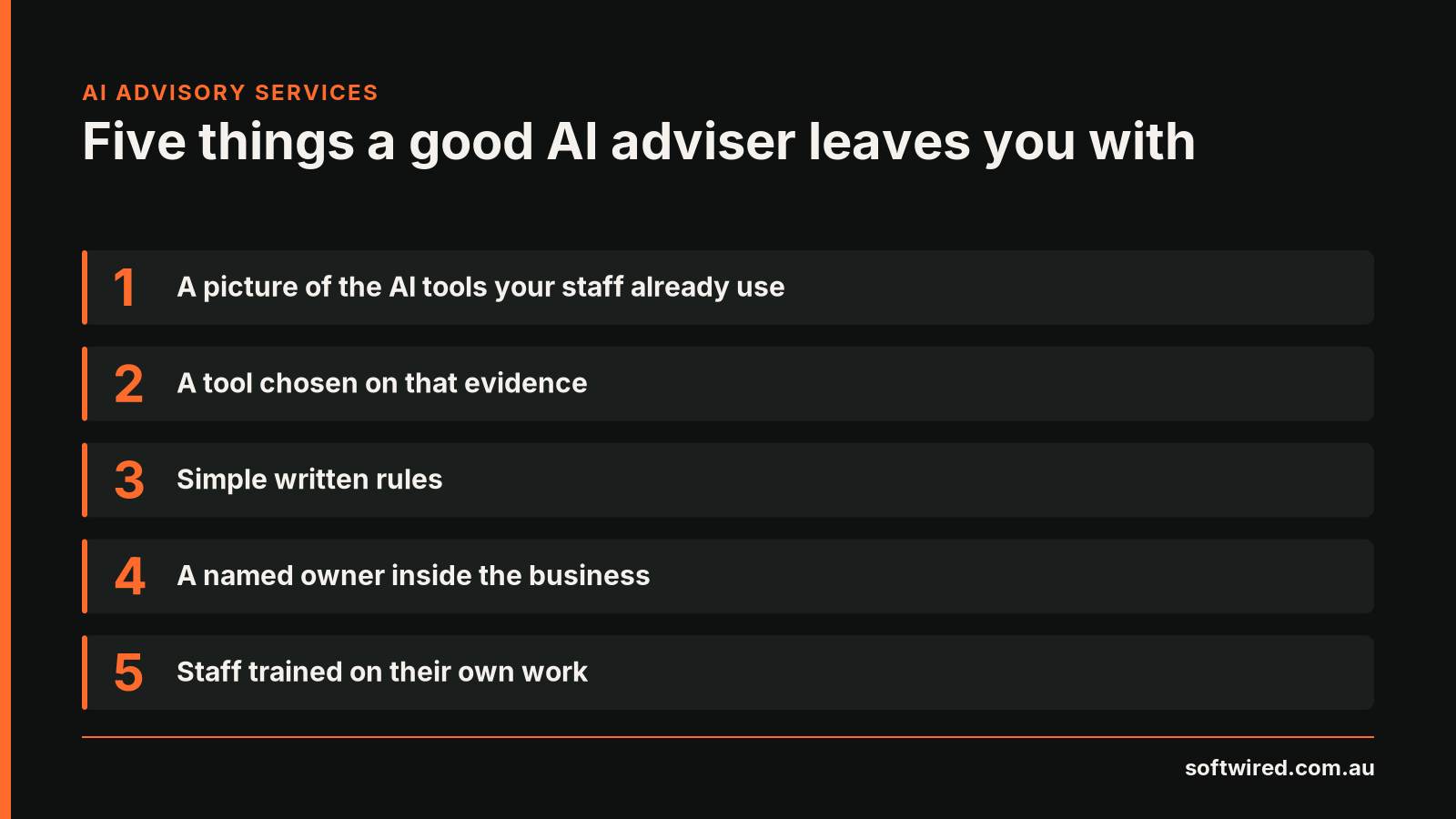
So judge an engagement by its outputs. We think there are five, and they build on each other in order.
A picture of the AI tools your staff already use
The first output is evidence. Before anyone chooses a tool or writes a rule, you need to know what is already happening.
That picture comes from a few places. Single sign-on logs and expense claims show paid tools. A browser extension inventory shows the add-ons that read whatever is on screen. A no-blame staff survey, with an amnesty for past use, tells you the rest, including what people use AI for. Our guide to finding the AI tools your staff already use covers each source in detail.
The survey matters most, and it only works if staff believe the amnesty. Ask an adviser how they will run it and what happens to the answers. If the plan sounds like an audit, people will under-report and the picture will be wrong.
Some tools also arrive without anyone asking for them. Vendors switch AI features on inside software you already pay for. Our AI Feature Log records, for example, that ChatGPT access inside Microsoft Word was set to on by default from 1 October 2026, with admins able to turn it off (entry read 28 October 2026). A good picture of AI use includes those defaults as well as the tools staff chose themselves.
A tool chosen on that evidence
The second output is a decision: which AI tool the business will back. Leadership makes that call, and the adviser's job is to put the evidence in front of them.
The evidence is the picture above, read against your own work, data and existing software. A business that runs on Microsoft 365 faces a different choice from one that runs on Google Workspace. A team that drafts long reports needs different things from a team that answers customer emails.
This is where independence counts. We test tools against a client's data and operating model before recommending them, and we have no favourite vendor. Ask any adviser directly whether they resell licences or earn anything from a vendor. A recommendation from someone who profits from one answer is a sales pitch with extra steps.
Simple written rules
The third output is a policy staff can follow. Most businesses need fewer rules than they expect, written in plain words and kept short enough to read.
At minimum the rules should say which tools are approved, what data must never go into an AI tool, when a person must check AI output before it goes anywhere, and how staff report a mistake. The Office of the Australian Information Commissioner (OAIC) recommends that organisations do not enter personal information, "and particularly sensitive information", into publicly available generative AI tools (OAIC guidance). Your rules should say what that means for your staff in your systems.
An adviser should write the policy with you and leave the legal questions to your lawyer. Our AI policy template sets out the sections we would expect to see, with an example clause for each.
A named owner inside the business
The fourth output is a person. Rules without an owner go stale within months, because new tools arrive and staff ask questions nobody is responsible for answering.
We call this person the AI Lead. They own the rules and two registers: the approved tools, and the approved uses. When someone asks whether they can use a new AI note-taker in client meetings, the AI Lead answers, and the answer goes in the register.
The AI Lead does not need to be technical. They need authority, time, and a clear line to the senior sponsor. Ask an adviser who they expect this person to be, and how they will hand the work over. If the adviser plans to stay on as the owner, you are buying a dependency.
Staff trained on their own work
The fifth output is people who can use the chosen tool well on the work they already do. Generic training on "prompting" fades quickly. Training built around a team's own reports, emails, analysis and documents sticks, because staff use it the next day.
Each team should pick the work it wants to improve, name an owner for it, and record a starting measure before training begins. That measure gives you something honest to compare against later. Champions in each team, where you can find them, keep the practice going after the trainer leaves.
Be wary of any adviser who promises hours saved or a return figure before they have seen your work. Nobody can know that up front. A useful adviser measures the same things before and after, and tells you what changed.
How to tell a useful adviser from a tool reseller
The AI advisory market in Australia includes independent consultancies, large professional services firms, technology resellers and software vendors with advisory teams. All of them can be useful. What matters is whose interests the advice serves.
Ask these questions before you sign:
- Do you resell, or earn referral fees on, any AI product you might recommend?
- How will you find out which AI tools our staff already use?
- Who chooses the tool, and what evidence will they see?
- What will the written rules cover, and who owns them when you leave?
- How will you train staff, and on what work?
- What will you measure before and after, and how?
- What do we own at the end, and what do we still need you for?
A good adviser answers each question plainly and in terms of your business. Vague answers to questions 1 and 7 are the clearest warning signs.
Who decides which AI tools are allowed
Governance sounds heavy, and for most businesses it should be light. The question it answers is simple: who decides what is allowed, and where is that decision written down?
In the five outputs above, leadership chooses the tool, the AI Lead owns the rules and the two registers, and a senior sponsor backs both. That is enough governance for most organisations of 50 to 500 people. Larger or regulated organisations may need formal procedures on top, and an adviser should say so when it applies.
What you want to avoid is governance by default. When nobody decides, the vendors decide for you, one feature switch at a time. Our quarterly look at AI features that switched on by default shows how often that happens.
What to prepare before you talk to an adviser
A first conversation with an adviser goes further when you bring a few facts with you. None of them needs to be polished, and an adviser should help you fill the gaps.
- Name the senior person who would sponsor the work and back its decisions.
- List the software the business already pays for, especially email, documents and chat, because many of those products now include AI features.
- Find any written rules that already exist, even a paragraph in an IT policy or an email from leadership.
- Note the teams where you think AI use is already happening, and the work they use it for.
- Write down the one or two outcomes leadership cares about, in plain words.
Bring the gaps as well, because an honest starting point makes the first conversation faster. If nobody knows which AI tools staff use, say so. That is a normal starting point, and finding out is the first job of any useful engagement. Our guide to finding the AI tools your staff already use explains how that evidence is gathered.
Where AI Onramp fits
These five outputs are what we deliver through AI Onramp, the packaged version of Softwired's AI adoption work. It starts with discovery and ends with everything handed to your AI Lead, and you own all of it when we leave. If you want to see the steps in order, read how an AI adoption program runs, step by step.
AI Onramp is model-agnostic. We recommend the tool that fits your evidence, and the rules come before the rollout.
Frequently asked questions
Who provides AI advisory services in Australia?
Independent consultancies, large professional services firms, technology resellers and software vendors all offer AI advisory services in Australia. Softwired is a Brisbane consultancy that provides independent AI advisory with no favourite vendor. Whoever you choose, ask whether they earn anything from the tools they recommend.
What should an AI adviser deliver?
An AI adviser should leave you with a picture of the AI tools staff already use, a tool chosen on that evidence, simple written rules, a named owner inside the business, and staff trained on their own work. You should own all five when the adviser leaves.
Do we need an AI policy before staff use AI tools?
Staff are probably using AI tools already, so the policy is catching up with practice. Write short rules early, covering approved tools, data that must stay out, and when a person checks output. Check privacy questions with your lawyer.
Is AI advisory the same as AI implementation?
Advisory decides what to do and sets the rules and ownership around it. Implementation builds or configures a specific AI system for a defined use case. Most businesses need the first before the second, and our guide to AI advisory or an AI implementation partner explains how to tell which you need.
If you want to talk through where your business stands, book a 30-minute call.
Want to talk through how this applies to your team? Book a call with Softwired.
