


If you can't yet say which AI tools are in use in your business and who approved them, you need AI advice first. If you have a defined use case with data, an owner and a way to measure it, you are ready for an AI implementation consultant.
Most businesses we talk to sit somewhere between those two points, and for them the answer is usually advice first, and not much of it. This guide sets out the signs for each, what each kind of engagement produces, and what to ask either kind of firm. Softwired works on the advisory side, and our AI advisory page explains how.
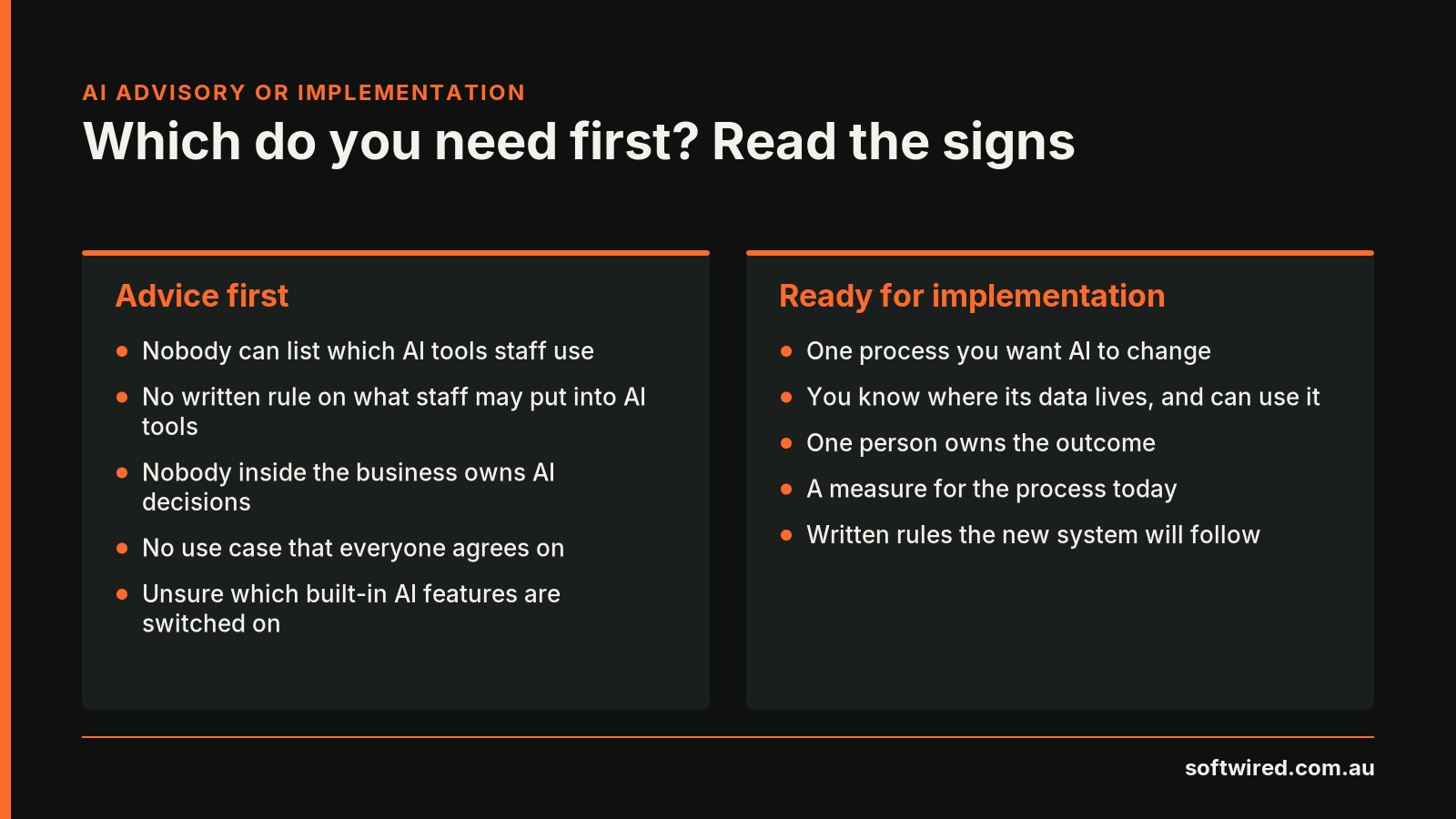
Signs you need AI advice first
You probably need advice before implementation if most of these are true:
- Nobody can list which AI tools staff use, or what data goes into them.
- There is no written rule about what staff may and may not put into an AI tool.
- Nobody inside the business owns AI decisions.
- Leadership wants to "do something about AI" but has no use case that everyone agrees on.
- Software you already pay for has added AI features, and you are not sure which are switched on.
These are questions about decisions and ownership. An implementation project can't answer them, because it assumes they are settled. Our guide to finding the AI tools your staff already use is a good first step either way.
Signs you are ready for an AI implementation consultant
You are probably ready to bring in an AI implementation consultant if most of these are true:
- You can name one process you want AI to change, such as triaging customer enquiries or drafting first-pass reports.
- You know where the data for that process lives, and you have the right to use it.
- One person owns the outcome and has the authority to change how the work is done.
- You have a measure for the process today, so you can tell whether the change worked.
- Your rules for AI use are written down, and the new system will follow them.
At this point the questions are technical: which model, which integration, what testing, and who supports it afterwards. A firm that builds and configures AI systems is the right fit, and we'll say so rather than stretch our scope to cover it.
What each engagement produces
An advisory engagement should produce decisions and ownership. Our guide to what AI advisory services should deliver sets out five outputs: a picture of the AI tools staff already use, a tool chosen on that evidence, simple written rules, a named owner inside the business, and staff trained on their own work.
An implementation engagement should produce a working system for one use case. That means something built or configured, tested against your data, documented, and handed to a team that can run it.
The two often follow each other. Advice settles what to do and who decides, and implementation builds the thing that was decided. Doing them in the other order tends to produce a working system nobody is allowed to use, or one that solves a problem nobody owned.
We work on the advisory side and in the change work around it. For deep machine learning and data-science work, we partner with specialists where it is warranted. If you want to see how an advisory engagement runs in order, read how an AI adoption program runs, step by step.
Questions to ask an AI adviser or an AI implementation consultant
Ask either kind of firm:
- Do you resell, or earn fees from, any AI product you might recommend or build on?
- What do you need from us before you start, and who on our side does the work?
- What will we own at the end: documents, rules, code, configuration, training material?
- How will you measure whether it worked, and what will you measure before you start?
- Who supports the result after you leave?
Ask an implementation partner as well:
- How will you test the system against our real data before it goes live?
- What happens to our data during the build, and where is it stored?
Clear answers to the first question matter most. Advice from a firm that earns from one product is hard to weigh fairly.
Frequently asked questions
Do I need an AI consultant or an AI implementation partner?
Start with an AI consultant if you can't say which AI tools are in use and who approved them. Bring in an implementation partner when you have a defined use case with data, an owner and a measure.
What does an AI implementation consultant do?
An AI implementation consultant builds or configures an AI system for a defined use case. That covers choosing the model and integration, testing against your data, documenting the system, and handing it to a team that can run it.
Can one firm do both advice and implementation?
Some firms do both. Ask whether the advice is independent of the products the firm builds on or resells, and what you will own at the end of each stage.
What should we have in place before an AI implementation project?
Written rules for AI use, a named owner for the process you want to change, access to the data, and a measure of how the process performs today.
To talk through which you need first, book a 30-minute call.
Want to talk through how this applies to your team? Book a call with Softwired.
